
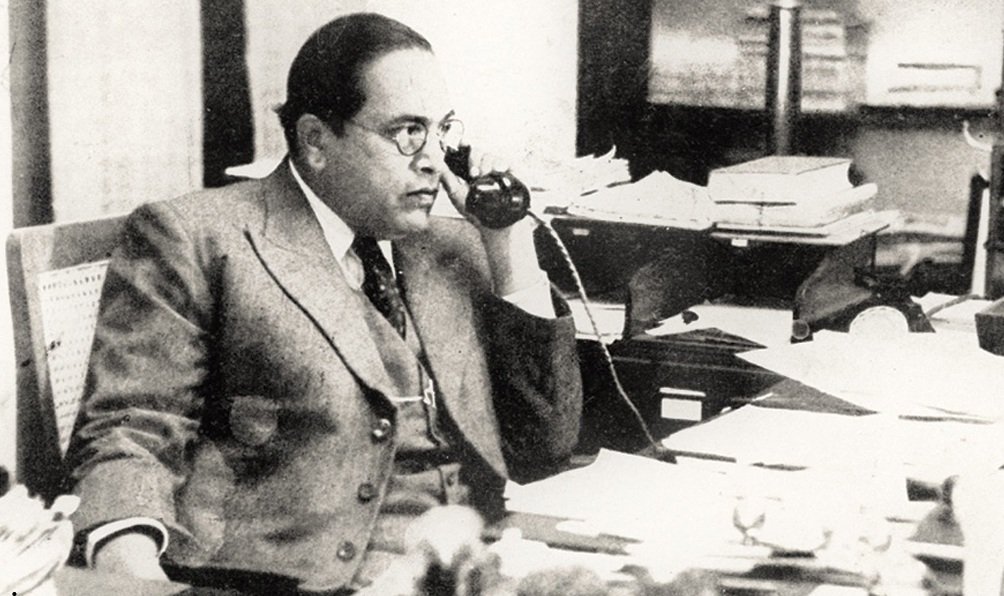
Dr. B. R. Ambedkar was the first Law Minister of modern India, serving from 1947 to 1951.
Dr. Bhimrao Ramji Ambedkar, popularly known as Babasaheb, was the principal architect of the Indian Constitution. He was an emancipator of Dalits, a visionary national leader, patriot, scholar, educationist, political thinker, and spiritual guide. Above all, he stood as a towering personality of unmatched intellect and courage, without any parallel among his contemporaries.
Dr. B.R. Ambedkar ( 14 April 1891 – 6 December 1956) was not merely a historical figure—he was a transformative force who reshaped India’s social and political foundation. Dr. Ambedkar’s vision transcended the boundaries of caste and class. He became the voice of millions who had been silenced by centuries of discrimination. His life symbolized the power of knowledge, the courage to dissent, and the unyielding pursuit of justice.
In a country struggling to define freedom in real terms, Dr. Ambedkar reminded everyone that political independence without social equality was hollow. His ideas continue to guide India’s journey toward inclusivity, human dignity, and democratic integrity.
Education as the Weapon of Liberation
Ambedkar’s journey began in an India steeped in caste discrimination. Born in 1891 in Mhow, Madhya Pradesh, he experienced humiliation from his earliest days because he belonged to the Mahar caste—deemed “untouchable.” Yet, rather than succumb to despair, he turned pain into purpose. For him, education was not just a personal escape but a collective weapon to break the chains of oppression.
Supported by the progressive ruler of Baroda, Maharaja Sayajirao Gaekwad, Ambedkar pursued his education relentlessly. He earned degrees from Bombay University, Columbia University, and the London School of Economics, achieving rare academic heights for any Indian of his time. His doctoral works—The Evolution of Provincial Finance in British India and The Problem of the Rupee—revealed his analytical genius and deep concern for India’s economic future.
Education transformed Ambedkar into a global thinker. He saw that social reform must begin with intellectual awakening, and that true freedom would come only when every Indian had access to learning.
The Social Reformer Who Challenged the Caste Order
Returning to India, Ambedkar confronted the harsh social realities that had haunted his childhood. The caste system, entrenched for centuries, denied dignity and opportunity to millions. Rather than accepting it as destiny, he decided to dismantle it through collective resistance and social reform.
In 1923, he founded the Bahishkrit Hitkarini Sabha to promote education and empowerment among the marginalized. The slogan he promoted—Educate, Agitate, Organize—became the guiding principle of India’s social justice movement.
Ambedkar’s activism took bold and visible forms. The 1927 Mahad Satyagraha was a defining moment when he led thousands of Dalits to drink water from a public tank, asserting their equal right to public resources. Similarly, the Kalaram Temple Entry Movement of 1930 challenged centuries-old religious exclusion. These actions marked the beginning of India’s struggle for social democracy—a fight not merely for reform but for recognition.
Ambedkar became a symbol of courage and defiance. He proved that revolutions could be fought with intellect, organization, and moral conviction rather than violence.
Architect of the Indian Constitution
When India gained independence in 1947, it faced the monumental task of building a nation on the principles of justice and equality. Ambedkar, appointed as the country’s first Law Minister, was chosen to chair the Constituent Assembly’s Drafting Committee. This was both a recognition of his brilliance and a moral turning point for India.
Under his leadership, the Constitution became more than a legal document—it became a social charter. It guaranteed fundamental rights, equality before law, and protection for the oppressed. It sought to dismantle caste barriers through affirmative action and to create a political structure rooted in accountability.
Ambedkar believed democracy was not merely a system of governance but a social ethic—a way of life based on liberty, equality, and fraternity. His words still resonate: “Political democracy cannot last unless there lies at the base of it social democracy.”
The Constitution, adopted in November 1949, stands as a living testament to his vision of justice and inclusiveness.
Conflict, Resignation, and Reflection
Despite his towering contributions, Ambedkar’s relationship with the political establishment was often strained. His proposed Hindu Code Bill, which aimed to reform personal laws and grant greater rights to women, met with resistance from conservative forces. Disheartened by the government’s reluctance, he resigned from the Cabinet in 1951.
His resignation was not a retreat but a reaffirmation of principle. He believed that social reform was inseparable from political progress. To him, India’s democracy would fail if it remained chained by social inequality. This moral consistency made him one of the most respected yet misunderstood figures in Indian politics.
Embracing Buddhism: A Revolution of the Soul
By the 1950s, Ambedkar realized that caste discrimination was too deeply rooted in Hindu orthodoxy to be reformed from within. Seeking a path of peace, dignity, and equality, he turned to Buddhism. On 14 October 1956, in Nagpur, he embraced Buddhism along with over half a million followers.
This was not just a religious act—it was a social revolution. By converting, Ambedkar and his followers rejected caste hierarchy and affirmed a new identity based on compassion and rationality. In his final work, The Buddha and His Dhamma, he articulated a modern interpretation of Buddhism—free from ritualism and grounded in ethics, equality, and reason.
Legacy: The Eternal Spirit of Justice
Dr. Ambedkar passed away on 6 December 1956 in Delhi, leaving behind an unparalleled legacy. His life’s mission—to restore dignity to the oppressed and justice to the nation—continues to inspire generations. Today, his portrait adorns government buildings, universities, and homes, not merely as a symbol of reverence but as a reminder of unfinished work.
His teachings remain profoundly relevant in a world still struggling with inequality. He envisioned an India where opportunity was determined by merit, not birth. His economic ideas—fiscal federalism, state intervention in welfare, and equitable growth—remain foundational to public policy. His social philosophy continues to influence movements for human rights, gender justice, and education.
Dr. Ambedkar taught that patriotism was not blind nationalism but the courage to question injustice. He once said, “Freedom without equality is no freedom at all.” That conviction still defines the moral core of India’s democracy.
The Leader Who Made India Listen
Dr. B.R. Ambedkar was a leader who never shouted, yet his words echoed louder than any slogans. He led a revolution of minds, not mobs. His greatest gift to India was the idea that democracy is meaningless without social justice and that justice is hollow without compassion.
He was, indeed, The Leader of the Silent—a reformer who gave voice to the voiceless, structure to a nation, and spirit to a Constitution. His journey from exclusion to empowerment remains one of humanity’s most inspiring stories.
In remembering him, we do not merely honour the past; we recommit to the future he envisioned—an India where every citizen stands equal in dignity, rights, and opportunity.
© 2025 greatindians.org